
SEEN a few big AFLW re-signing announcements of late?
After years of contracts capped until the end of 2027 (the final year of the current Collective Bargaining Agreement), clubs and players are taking tentative steps to sign agreements beyond the cut-off.
Eden Zanker at Fremantle was one of the first public announcements, signing a deal to the end of 2029 as part of her trade from Melbourne.

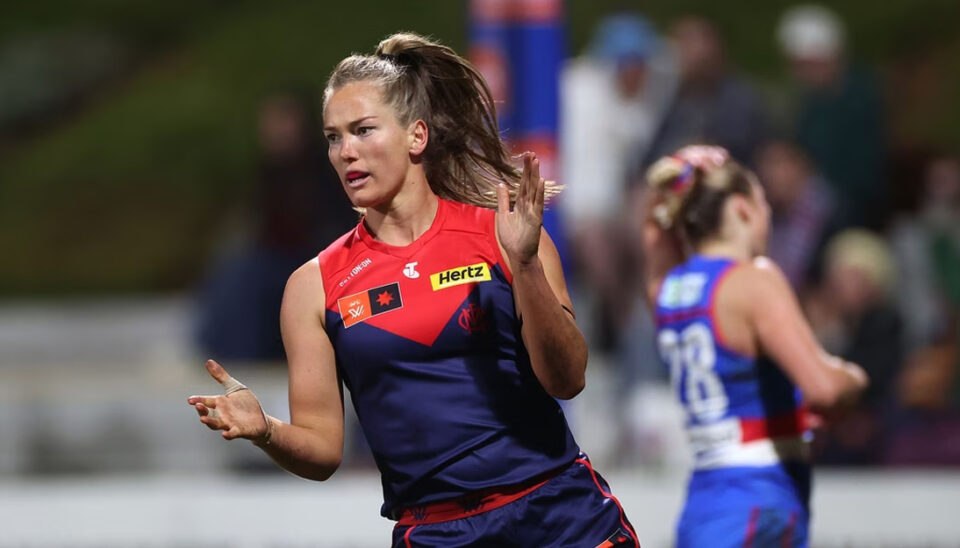
Eden Zanker in action during Melbourne’s clash with Brisbane in AFLW round 11, 2025. Picture: AFL Photos
New teammate Sarah Verrier signed till 2028, then developing Carlton star and South Australian Poppy Scholz signed a deal for 2029, and Brisbane livewire Belle Dawes was locked away for 2028.
But with no CBA in place beyond 2027, how are these deals being done? Why? What’s the risk of a long-term deal in the AFLW? How does the new salary cap affect matters?
And how does Tasmania fit into it all?

Belle Dawes in action during the 2025 NAB AFLW Grand Final. Picture: AFL Photos
A memo was sent from the AFL to clubs at the end of November last year, laying out how contracts could now be submitted beyond 2027.
There are essentially currently three groups of contracts:
- Those signed until the end of 2026 and 2027 (the vast majority of players)
- Those signed in the past few months (pre-salary cap), that go beyond the end of 2027 (Zanker, Scholz etc)
- Those which will be signed post the introduction of the salary cap in 2027, and will go beyond one season
For the group who have extended beyond the end of 2027, but signed before the introduction of the salary cap, their payment is based on existing tier amounts. These contracts are binding (as is the case for men’s contracts), despite the absence of a CBA for a portion of the time-frame.

Poppy Scholz celebrates a goal during the AFLW Preliminary Final between Brisbane and Carlton at Brighton Homes Arena on November 22, 2025. Picture: AFL Photos
Future contracts can now include a “ratchet clause” to allow contracts to be increased by an agreed amount, in the case the total player payment limit goes up by a certain amount.
Signing beyond the CBA’s end may be done for a number of reasons for both the player and club. It provides players with an additional layer of security, which could be particularly important for those who have moved interstate, are planning future study or looking to buy a property.
What about Tasmania?
Recruiting duo Todd Patterson and Cody Baker worked together at Melbourne, and are known for their nous and ability to land deals. Patterson has worked in the AFLW space from its very beginnings, and has networks across the country.
Clubs will be able to protect roughly six players from Tasmania in rules released at the end of last year, although it could be as little as three or as high as 12 depending on competitive balance.
If contracted players are not within that protected bracket, they can take up a Devils contract should they wish to do so.
This means that if Tasmania offer a contract to Scholz, and she’s not in Carlton’s protected players, she could choose to move, despite the fact she’s signed to the Blues till 2029.
