
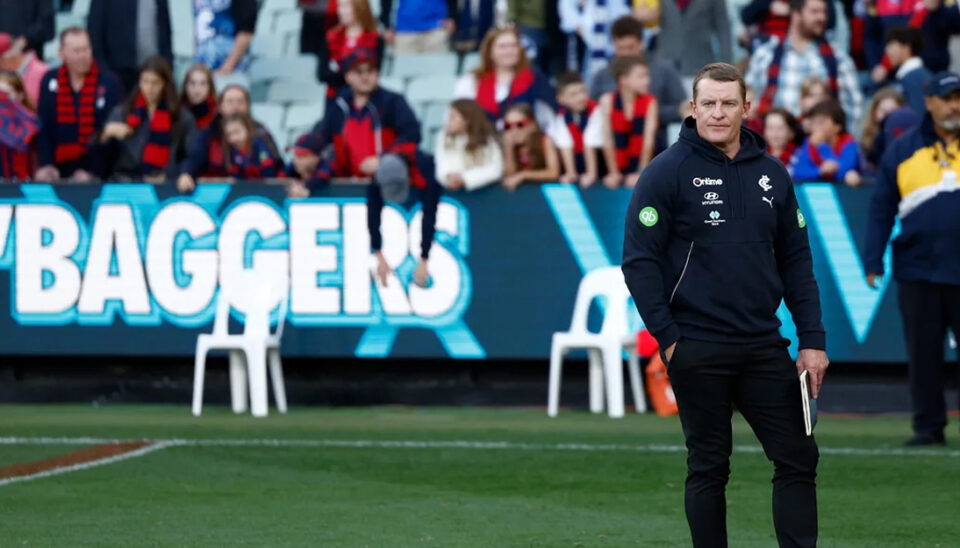
CARLTON is the living, breathing reflection of the famous Irish football manager Mick McCarthy’s quote.
“It can’t go on like this, can it?”
“It can.”
Even when the Blues roared into an early 43-point lead in the second quarter of Sunday’s demoralising loss to the Demons, there was a sense of inevitability about what was to follow. The question on everyone’s lips was how, and when, will this go wrong?
Turns out, the answer was: Exactly the same way as every other time.
Fast start, slowed, then completely overrun.

The numbers paint a damning story for Carlton. Its percentage in first quarters this season is a whopping 368. Its percentage in second quarters is 109.76. Its percentage after half-time is just 35.44.
That, alone, would be enough to warrant an inquest. The fact it’s the tale of a tape nearly two years in the making, dating back to a specific point midway through the 2024 campaign, is enough for more than just introspection. It is, in reality, enough to warrant change in significant areas of the football club.
The spotlight will, once again, fall on senior coach Michael Voss. After he was emphatically backed by new chief executive Graham Wright late last season, a decision unanimously endorsed by the club’s board, the hierarchy at Ikon Park has repeatedly stressed it would give him the entirety of 2026 to prove his mettle.
But be it now, midway through the season, or at the conclusion of what now shapes as being yet another doomed campaign, the sheer weight of evidence looks destined to fall against Voss.

The Blues spoke all summer of how personnel changes had led to a “vibe shift”. Indeed, across pre-season in optimism-inducing wins over last year’s Grand Finalists in Brisbane and Geelong, it had looked faster and bolder. It’s taken barely a month for such optimism to be completely eroded, though.
And that might be what defines Carlton’s impending Voss decision. The personnel has changed so much – Sunday’s defeat featured seven players who didn’t kick a ball for the Blues last season and a further five who played 10 games or less – and yet the side’s identity has barely changed.
Fast start, slowed, then completely overrun. The same Carlton.
Voss would be able to trace the turning point back to midway through 2024 in a game against Greater Western Sydney, when Carlton charged into an early 39-point lead only to be downed comfortably. The Blues were 11-4 at the time, one of the form teams of the competition, and seemed destined to be a premiership contender.
They’re 12-23 since. Of those 12 victories, eight have come against last year’s bottom four sides North Melbourne, West Coast, Essendon or Richmond. Only one – last year’s win over Geelong – came against a side that ultimately played finals.
Included in that run have been the 39-point lost lead to the Giants and a later 31-point lost lead to Port Adelaide in 2024. Last year, they dropped leads of 41 points to Richmond, 24 points to the Bulldogs and 24 points to Fremantle.

Carlton players looks dejected after their loss to Melbourne at the MCG in round three, 2026. Picture: Getty Images
Already this year, they’ve dropped a 22-point lead to Sydney and now a 43-point lead to Melbourne. Their only win, a nervous four-point victory over Richmond, came after they’d led by 29 points only to kick one goal for the entire second half.
In eight of their 16 defeats since the start of last season, they have led at half-time. It’s the most of any team in the League across that period, with West Coast (seven defeats while leading at half-time) the only other side close to that number.
Since the start of last year, Carlton is 18-8 with a scoring differential of +189 in first halves. But the Blues are 7-19 in second halves, while their scoring differential drops to a remarkable -333 after the main break.
Break it down into individual quarters and the pattern repeats itself. In the 26 games since the start of last season, the Blues are 18-8 in first quarters. Great. They’re 12-14 in second quarters. A little worrying. They’re 5-19-2 in third quarters. Bad.
The story is always the same. Fast start, slowed, then completely overrun.
Sunday’s game, though, might have been the worst of them. Melbourne had tallied just six points heading into the final 60 seconds of the first half. The fact a young, inexperienced Demons side under a two-game head coach then compiled a 100-point scoreline even overshadowed the third-quarter collapse against Sydney and the second-half no-show against Richmond.
The Blues looked timid, fragile and slow. At times, even when they still held a significant scoreboard advantage, they looked resigned to their fate. Any sign of the pre-season promise had disappeared out of sight. They had wanted to be faster, exciting and more dynamic. They look a long way off that.
“I don’t know what it looked like today, but it feels like we tend to go safe in those moments and we don’t take the game on,” Blues skipper Patrick Cripps said after the lamentable loss to the Demons.

Max Gawn and Patrick Cripps embrace after the match between Carlton and Melbourne at the MCG in round three, 2026. Picture: AFL Photos
Voss last Thursday, when asked if Carlton needed to be braver when holding on to late leads, replied: “Bravery and stupidity are very, very close sometimes.” He was right. But the Blues have been more stupid than brave recently.
The countless second-half mistakes on Sunday were a sign of that. Freezing up in possession of another big lead as well. The complete lack of accountability for Kysaiah Pickett, Melbourne’s biggest game changer, was the greatest tell of all.
So, bravery or stupidity? Surely it’s time to give the alternative a try.

