
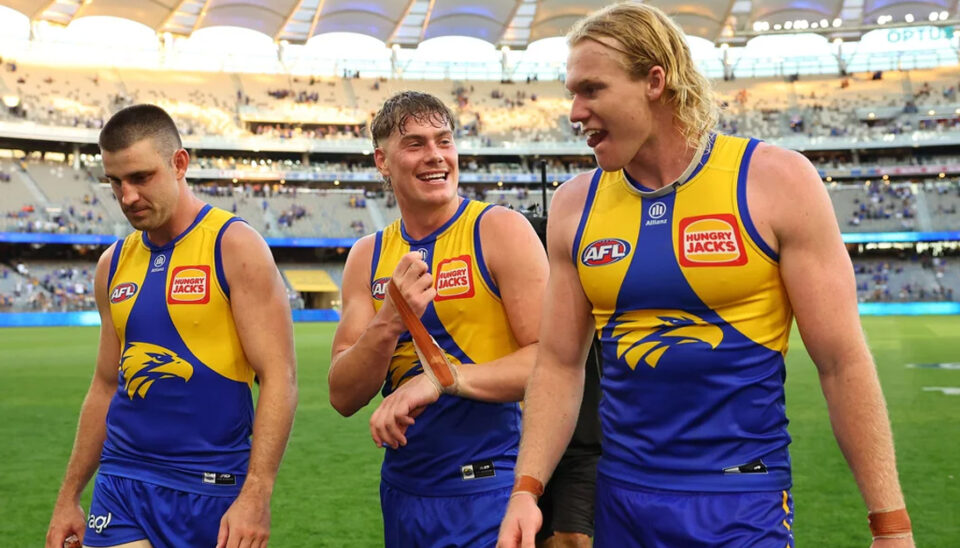
WEST Coast will embrace the challenge of travelling to play at the historically early time of 9.30am AWST on Sunday, with the club using subtle methods this week to adjust the body clocks of its players.
The Eagles and Port Adelaide will clash at Adelaide Oval at midday local time, presenting West Coast with the earliest start to a game a WA team has ever faced using its own local time.
The team will fly out on Friday, giving the players two days to adjust their body clocks in Adelaide if that is their preference, while they have started the process this week of adjusting sleeping hours in anticipation of the game.
Coach Andrew McQualter played down the logistical challenge and said it was part of being a WA-based AFL team.
“It is what it is, and we’re probably fortunate because we play two or three of our pre-season games at that time anyway,” McQualter said on Thursday.
“Our guys are pretty accustomed to getting up early and performing, so we’ll go over tomorrow and have a couple of days to get our body clocks sorted.
“We’ve been doing that already this week, and it’s part of the preparation of AFL footy.
“Ultimately our job is to turn up and perform.”

AFL chief executive Andrew Dillon said ensuring the Eagles could return home on Sunday night before a Saturday game against Sydney was part of the reasoning behind their early start time, highlighting other considerations.
“There’s a lot of things that go into the fixture. There’s venue availability, broadcast and the like. It’s not unprecedented,” Dillon said.
“What was important for West Coast was playing a big game against Port Adelaide and then with a six-day break ahead of a game at Optus Stadium on Saturday night, getting them home to WA on that Sunday night is important for them.”
High performance manager Phil Merriman joined West Coast ahead of the 2026 season after a successful stint with Fremantle, where he implemented a ‘Docker dial’ system to keep travelling players on Perth time if it worked better for them.
Players were given freedom, however, to decide their preference when on the road, with the Eagles making gradual adjustments this week to move closer to Adelaide’s time zone.
“It’s really simple things. Like all week we’ve been trying to go to bed 15 minutes earlier and wake up 15 minutes earlier,” McQualter said.
“It’s just normal stuff that West Coast has had to deal with its whole existence. There’s a bit of science behind it, and our guys have done a great job of preparing our players.”

The Eagles will need to replace key defender Harry Edwards this week after he entered concussion protocols, with Reuben Ginbey a likely option to stay in a key defensive role after covering for Edwards on North Melbourne key forward Nick Larkey last Sunday.
Sandy Brock is also pushing to return from an ankle injury and could be considered.
The Eagles will also need to replace pre-season selection Milan Murdock, who has been a revelation in his first two AFL games as a forward/midfielder before suffering a hamstring injury.
McQualter said former Adelaide midfielder Harry Schoenberg and small forward Malakai Champion were among the options for the match committee to consider.

Harry Schoenberg evades his opponent during the AAMI Community Series match between West Coast and Port Adelaide at Mineral Resources Park on February 29, 2026. Picture: AFL Photos
“He (Murdock) hasn’t had a hamstring injury before, so this is new for him, but he’s an optimistic person and he’ll be attacking his rehab the way he attacks his football and hopefully it’s not too long on the sidelines,” the coach said.
“The role of our small forwards is to pressure and create scoring opportunities, and he was providing both of those capabilities.
“He (Champion) has been building his form the last few weeks, and he’s been quite impressive in the WAFL, so he’s certainly coming into calculations.”
The Eagles were comprehensively beaten by Port Adelaide during the pre-season, losing their AAMI Community Series clash by 73 points at Mineral Resources Park but learning lessons about how to handle opposition pressure.
Coming off an impressive win against North Melbourne last Sunday, McQualter said his team had maintained a consistent approach to its preparation and moved on quickly to the Power.
“We reviewed the game exactly the way we’ve reviewed all our games this year, where we learn what we did well, what we executed well and what didn’t work for us,” he said.
“The scoreboard gives you belief in what you’re doing, and our group got that on the weekend, but we played far from the perfect game.
“We’ve still got a hell of a long way to go, so there’s an understanding that we’ve got to have that amount of effort every week to compete against AFL teams.
“So we reset the clock and go again.”
